
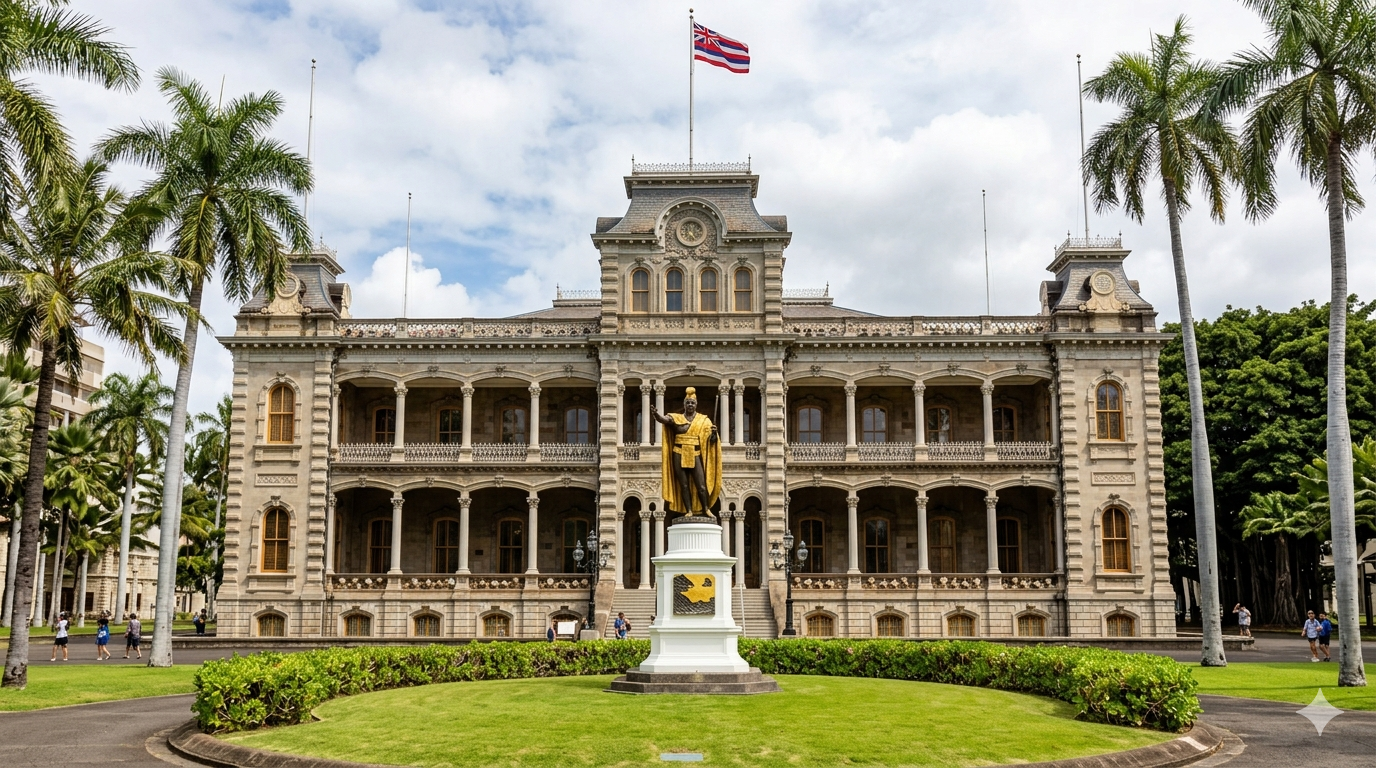
Iolani Palace Honolulu: History, Tickets and Visitor Guide
Iolani Palace sits right in downtown Honolulu.
Surrounded by the city, it still manages to stand apart. The kind of place that catches your attention even before you realize why.
And once you do, it’s hard to ignore.
The History of ʻIolani Palace
ʻIolani Palace was built during the reign of King Kalākaua, who wanted a royal residence that reflected how Hawaiʻi saw itself in the late 19th century: modern, independent, connected to the world, and culturally proud.
The cornerstone was laid on December 31, 1879, and construction was completed in 1882. The palace became the official residence of the Hawaiian monarchs, where they received international guests, hosted formal events, conducted political affairs, and entertained in a way that reflected the kingdom’s global presence.
That part is easy to miss if you only think of Hawaiʻi through beaches and vacation images.
ʻIolani Palace tells a different story. It shows a Hawaiian Kingdom that had diplomacy, ceremony, technology, music, politics, and a royal court. The building had modern features for its time, including electricity, indoor plumbing, and a telephone system.
Those details matter because they change the way many visitors understand Hawaiian history. The palace does not feel like a relic from an isolated island. It feels like a statement.
Then the story changes.
After King Kalākaua died, his sister Queen Liliʻuokalani became Hawaiʻi’s reigning monarch in 1891. She tried to strengthen the political power of the Hawaiian monarchy, but opposition from the Committee of Safety led to the overthrow of the monarchy in 1893.
After the overthrow, ʻIolani Palace was no longer used as a royal residence. It became government headquarters for the Provisional Government and later served as the capitol building through the Republic, Territory, and State of Hawaiʻi.
Many original furnishings were sold, removed, or returned to the royal family, and the palace changed dramatically over time.
Walking through it now, you are not just seeing a restored palace. You are seeing a building that has lived several lives.
A royal residence. A political center. A place of loss. A government building. And now, a museum of monarchy history.
That layered history is what gives the visit its weight.
Touring the Palace
Inside ʻIolani Palace, people naturally slow down.
The building asks for it.
The first floor includes the public rooms, where official receptions, ceremonies, dinners, and formal gatherings once took place. Visitors can see spaces such as the Grand Hall, State Dining Room, Blue Room, and Throne Room.
The second floor includes more private areas, including the King and Queen’s suites, the Music Room, and the Imprisonment Room, the room connected to Queen Liliʻuokalani’s imprisonment.
The Grand Hall is usually one of the first spaces that catches people’s attention. It feels open and formal, with the staircase, woodwork, and proportions doing most of the talking.
The Throne Room is different. It is grand, but it also feels strangely quiet once you understand what happened here.
This was a place of ceremony and power, but the palace is also tied to the end of the Hawaiian monarchy.
Upstairs, the visit becomes more intimate.
The rooms feel smaller. The story feels closer. You move from the public image of royalty into personal spaces, private quarters, and eventually the room connected to Queen Liliʻuokalani’s imprisonment.
That room changes the mood of the tour.
Even if you have read about the overthrow before, standing inside the palace gives it a different kind of weight. It is not just a paragraph in a history book anymore. It is a place, with walls, windows, silence, and context.
Guided Tour or Audio Tour?
There are two main ways to visit ʻIolani Palace: a guided tour with a palace docent or a self-led audio tour. Both options include the first and second floors of the palace.
A guided tour is usually the better choice if you like stories, context, and small details that you might miss on your own.
Docent-led tours explain the palace’s history from its completion in 1882 to the overthrow of the Hawaiian monarchy in 1893, along with stories about the royal residents, furnishings, staterooms, private quarters, and basement galleries.
The audio tour is better if you prefer to move at your own pace. It gives you more flexibility and still helps you understand what you are seeing.
Neither option is wrong.
If you are deeply interested in Hawaiian history, choose the guided tour. If you are visiting with a looser schedule or prefer quiet, choose the audio tour.
Either way, do not rush it. ʻIolani Palace is not a place where you need to see everything fast. The details matter more when you give them time.
What Makes ʻIolani Palace Different?
The most obvious answer is that ʻIolani Palace is the only official royal residence in the United States. That fact alone makes it unique.
But the deeper reason it feels different is that it challenges the usual tourist image of Hawaiʻi.
Many visitors come to Oahu thinking about Waikiki Beach, Diamond Head, surf towns, snorkeling, food trucks, and scenic drives. All of those things are part of the island experience.
But ʻIolani Palace tells another part of the story.
It shows Hawaiʻi as a kingdom with its own government, monarchs, diplomatic life, formal ceremonies, and global connections. It also shows how quickly that world changed after the overthrow.
That is why the palace can feel beautiful and uncomfortable at the same time. The restored rooms are impressive, but the history behind them is not simple.
And honestly, that is what makes it more meaningful than just another pretty building.
Visiting ʻIolani Palace
ʻIolani Palace is located at 364 South King Street in downtown Honolulu, a short drive or bus ride from Waikīkī.
Because it is downtown, the visit fits well into a Honolulu history day. You can pair it with nearby landmarks such as the King Kamehameha Statue, the Hawaiʻi State Capitol, Kawaiahaʻo Church, Aliʻiōlani Hale, or the Honolulu Museum of Art.
You do not need an entire day here, but you should not treat it like a five-minute photo stop either.
Plan for at least 60 to 90 minutes for the tour itself, plus a little extra time for the palace exterior, photos, and the nearby historic sites.
Reservations are highly recommended, and walk-ins depend on availability. Tours are usually offered Tuesday through Saturday, but it is always worth checking the official schedule before you go.
A few things to know before visiting:
Shirts and footwear are required. Shoe coverings are provided and worn inside the palace. Beachwear is not appropriate. Large bags, backpacks, luggage, food, and drinks are not allowed inside. Photography is allowed for personal use, but flash, video, audio recording, tripods, selfie sticks, and extended lenses are not permitted.
The shoe covers may feel a little awkward at first, but you forget about them quickly.
They also remind you that this is not just a tourist stop. It is a preserved historic and cultural site.
Is ʻIolani Palace Worth Visiting?
Yes, especially if you care about history, culture, architecture, or understanding Oahu beyond beaches.
It is not the loudest attraction on the island. It is not built around big views, adventure, or entertainment. But it gives visitors something different: context.
After visiting ʻIolani Palace, the rest of Honolulu can feel a little different. Street names, statues, buildings, and Hawaiian cultural references start to connect in a deeper way.
It is also a good choice for travelers who want a quieter activity in Honolulu.
You can visit in the morning, have lunch downtown or in Waikiki, and still have the rest of the day for the beach, shopping, or another nearby attraction.
For first-time visitors, it is one of the best places to begin understanding that Hawaiʻi is not just a vacation destination.
It is a place with a complex history, a living culture, and a royal past that still matters.
Tips for Visiting ʻIolani Palace
Book your tour ahead of time. Ticket sales are usually handled online, and same-day walk-ups are not guaranteed.
Choose a guided tour if you want more context. The palace is beautiful on its own, but the stories make it much more meaningful.
Do not dress like you are going straight from the beach. ʻIolani Palace asks visitors to dress respectfully because of the site’s cultural and historical significance.
Give yourself time to look around outside. The building exterior and nearby historic landmarks are part of the experience.
Pair it with other downtown Honolulu sites. The King Kamehameha Statue, Aliʻiōlani Hale, Hawaiʻi State Capitol, and Kawaiahaʻo Church are all nearby.
Do not rush the Imprisonment Room. It is one of the most emotionally important parts of the visit.
Check the official schedule before going. Tour times and availability can vary by day.
- Book your tour ahead of time
- Choose a guided tour if you want more historical context
- Wear respectful clothing and proper footwear
- Plan extra time for the palace exterior and nearby landmarks
- Do not rush through the Imprisonment Room
- Check the official schedule before visiting
Nearby Places to Visit
ʻIolani Palace is in one of the best areas of Honolulu for a history-focused walk.
Nearby, you can visit the King Kamehameha Statue, one of the most photographed landmarks in downtown Honolulu. Just across the street, Aliʻiōlani Hale adds another historic and architectural stop.
The Hawaiʻi State Capitol is also close, offering a more modern contrast to the palace.
Kawaiahaʻo Church is nearby as well and is often called one of the most important churches in Hawaiʻi’s history.
If you want to make the day more complete, you can combine ʻIolani Palace with the Honolulu Museum of Art, Chinatown, or a relaxed lunch in downtown Honolulu before heading back to Waikiki.
This is one of the easiest cultural stops to add to a Waikiki stay because it does not require a long drive across the island.
It gives you a deeper historical experience without taking over your entire day.
Highlights
- Only royal palace in the United States
- Located in downtown Honolulu
- Grand Hall with koa wood staircase
- Throne Room used for formal ceremonies
- Room where Queen Liliuokalani was held
- Mix of original and restored interiors
- Palace grounds open to the public

Where to Stay Near Iolani Palace

Staying near Iolani Palace makes it easier to enjoy the area with more comfort and less time spent driving.
Staying near ʻIolani Palace makes it easier to visit one of Honolulu’s most important historic landmarks with more comfort and less time spent driving.
With vacation rentals in the heart of Honolulu and Waikiki, just a short drive from ʻIolani Palace, guests stay close to the city’s beaches, restaurants, shopping, and ocean views while still having easy access to this important cultural landmark.
ʻIolani Palace is a meaningful place to visit for anyone interested in Hawaiian history, architecture, and the legacy of the Hawaiian Kingdom. Staying in this area also makes it easy to combine the palace with other Honolulu experiences, such as spending time at Waikīkī Beach, visiting the famous Duke Paoa Kahanamoku Statue, walking along Kuhio Beach, taking a boat tour or coastal cruise, or adding Honolulu Zoo to the itinerary.
Staying here goes beyond simply choosing a place to stay. It’s about having a comfortable city base close to one of Oahu’s most important cultural landmarks and some of Waikiki’s most iconic areas. Our Honolulu and Waikiki vacation rentals are fully equipped, offer views toward Waikīkī Beach, and create a welcoming space to return to after exploring the city.